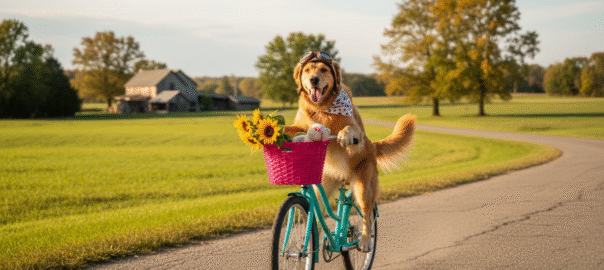
Something has shifted in online pet content, and it matters for the safety of real animals. AI-generated pet videos have become increasingly difficult to distinguish from authentic footage — and they’re circulating alongside real content in the same feeds, with the same enthusiastic sharing. When pet parents watch an AI-generated video showing a dog performing a physically impossible trick or a cat doing something no cat could safely do, they don’t always know they’re watching computer-generated content. Sometimes they try to recreate it.
Detecting fake pet videos isn’t about becoming suspicious of everything online. It’s about developing a specific skill to protect your pet from the latest forms of digital misinformation. And, it gives real meaning to that old saying from TV, “Don’t try this at home!”
Why AI-Generated Pet Content Is a Real Risk
The concern with AI pet content isn’t that it exists. It’s that it normalizes impossible or unsafe behaviors by making them look real and achievable. A clearly animated pet doing something impossible presents no real risk. A photorealistic AI-generated video of a small dog leaping from a second-story balcony and landing safely, indistinguishable from authentic footage, is a different matter entirely.
AI technology for generating realistic animal videos has improved dramatically since its inception. Tools that once produced obviously artificial results now generate footage that passes casual scrutiny. The timeline between “AI generates it” and “pet parent tries it with a real animal” can be very short on platforms designed for rapid content spread.
In fact, research shows humans can detect AI-generated videos with only 51% accuracy — essentially a coin toss. (Cooke et al., Communications of the ACM, 2025)
The secondary risk involves realistic expectations. When AI pet content depicting perfect, instant trick training, extreme athletic performance, or human-like behavior circulates widely, it creates a distorted baseline for what’s normal and achievable. Real pets — with real physical limits, real learning timelines, and real stress responses — can’t compete with a generated ideal. That mismatch creates frustration, pushes pets beyond safe boundaries, and erodes the realistic understanding of animal behavior that keeps pets safe.
Six Red Flags for AI-Generated Pet Videos
AI pet video recognition doesn’t require technical expertise. It requires slowing down briefly and knowing where to look.
Physically impossible movement. The most reliable indicator of AI-generated content is physics that doesn’t work: a cat landing from a height with no impact, a dog’s spine bending in a direction spines don’t bend, a rabbit jumping a distance that exceeds the species’ capability by an obvious margin. Real animals are constrained by anatomy. Generated animals aren’t.
Suspiciously flawless execution. Real animals make mistakes. They hesitate, overshoot, lose balance, and try again. A video in which every movement is perfectly calibrated — no false starts, no corrections, no natural variation — is showing something other than a real animal doing a real thing.
Background or lighting inconsistencies. AI generation still struggles with environmental coherence. Shadows that don’t match the light source, backgrounds that blur or shift unnaturally at the animal’s edges, and reflections that don’t correspond to the scene are artifacts of generation that survive into the final video.
Edges that don’t quite resolve. Where fur meets background, where a paw meets a surface, where a tail moves against a wall — these boundary areas often show subtle blending or morphing in AI-generated content. It may look slightly soft or slightly wrong without being immediately obvious why.
Proportions or anatomy that shift between frames. A pet’s ears, eyes, or limbs that look subtly different from one moment to the next, or proportions that are slightly more “ideal” than a real animal’s natural asymmetry, are signatures of generation rather than photography.
Context that doesn’t quite add up. Real animals in real videos have real contexts: a background that makes sense for the behavior, a relationship with a handler that develops logically, a setting appropriate to the activity. AI-generated content sometimes places animals in contexts that prioritize visual impact over coherent reality.
But red flags or not, bigger challenges lie ahead. The visual tells that once helped people spot deepfakes — like flickering around eyes and jawlines, unnatural movements, or lighting inconsistencies — have largely disappeared as AI technology has improved (Lyu, The Conversation; Cooke et al., Communications of the ACM). Stanford professor Maneesh Agrawala warns that as deepfake technology improves, our ability to detect it will continue to decline (Agrawala, Stanford HAI). This creates an arms race where the fakes are always one step ahead of our detection capabilities.
Dr. Stephany Vasquez in Reno, Nevada, focuses on longevity and the pet’s comfort. Here’s her take:
As a veterinarian, I help families separate online trends from what’s truly appropriate for their individual pet. A three-year-old Border Collie athlete is not physiologically comparable to a twelve-year-old Bulldog with arthritis — even if both videos show dogs hiking mountains or training for marathons.
My advice is simple: build goals around your pet’s body, not someone else’s highlight reel. Longevity and comfort matter far more than performance. When expectations align with biology, pets thrive — and we prevent the silent injuries and setbacks that often follow well-intentioned but unrealistic standards.
The Normalization Problem
Beyond individual videos, there’s a pattern worth paying attention to: when impossible becomes commonplace in a feed, the baseline for “normal” shifts. When AI-generated pet content depicting extreme agility, effortless training, or physical capabilities well beyond species norms circulates alongside authentic footage, pet parents absorb a distorted picture of what their pets should be able to do. Breed-specific limitations, age-related changes, and individual health considerations get edited out of the online version of pet life.
This matters because it influences decisions: how hard a pet gets pushed during training, whether joint pain is taken seriously, and whether a pet’s reluctance to perform a trick is respected or overridden. Protecting pets from AI trends means maintaining a clear picture of what real animals can and should do.
How to Verify Before You Try
The practical question when encountering pet video content is whether what’s depicted is physically possible for your specific pet — not just for a hypothetical healthy adult version of their species, but for your individual animal at their current age, with their particular health history.
A reverse image or video search can sometimes surface the original source of content or reveal that it’s been identified elsewhere as AI-generated. Checking a creator’s broader content library is also informative. Accounts that consistently produce content that’s overly perfect, overly dramatic, or overly repetitive across many videos are worth additional scrutiny. When something seems physically impossible, it’s worth acting on that instinct rather than overriding it. If it seems impossible, it probably is. When in doubt, screenshot and ask your veterinarian before attempting to recreate anything.
The House Call Advantage for Realistic Expectations
One of the practical benefits of house call veterinary care is the opportunity to observe your pet in their real environment — how they actually move, what their natural range of motion looks like, where they’re stiff, and what they genuinely enjoy doing. That baseline observation, accumulated over multiple visits, gives house call veterinarians a specific ability to help pet parents evaluate viral content against the reality of their individual animal.
Questions like “could my dog actually do something like this?” or “is that level of flexibility normal for her?” are well-suited to house call conversations, where there’s time to discuss them properly and a foundation of relationship and observation to draw on.
Dr. Emily Dae Andersen, a Heal house call vet in Bethel, CT, especially values the insights she gains when she sees pets in their own home. She writes:
House calls inherently build more trust in the comfort and safety of one’s home. Pets are less stressed, and owners are less stressed. Rapport is more naturally built. That’s the framework that allows pet parents to feel comfortable asking questions and veterinarians to have time to fully answer them. Additionally, being in an animal’s living space provides valuable insights into how we can best implement effective, tailored tools to improve their care and quality of life. We value the trust placed in us when we are welcomed into the home. With this trust, we can discuss patient care goals and questions more honestly and openly. This also sets the tone for communication after the visit, as questions naturally arise. We hope pet parents feel comfortable reaching back out with follow-up questions.
AI-generated pet content will continue to improve in quality. For now, the most reliable protection remains a combination of specific visual skepticism, realistic knowledge of your pet’s individual capabilities, and a veterinary relationship built on enough time to have the conversations that matter.
Be sure to check out the rest of our series on Social Media and Pets:
Article 1: Is Social Media Hurting Your Pet?
Article 2: Why Good Pet Parents Fall for Misinformation
Article 3: Pet Health Fact-Check Guide
Article 4: Is That Pet Video a Deep Fake?
Article 5: Who to Trust for Pet Advice
Quick question about something seen online? Book an affordable telemedicine consultation with a house call veterinarian. Heal provides science-based guidance tailored to specific pets’ needs, helping pet parents navigate the overwhelming world of online pet advice.