A Mobile Veterinarian for Central Massachusetts
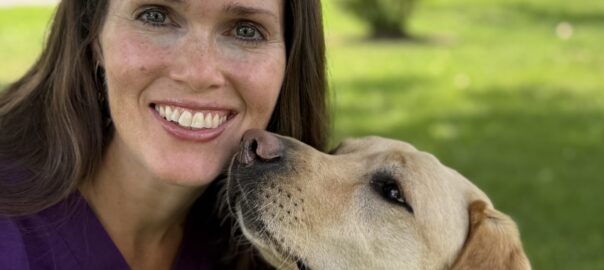
I’m Dr. Katie Holmes, and I am genuinely excited to be building my house call practice here in the Blackstone Valley, serving Douglas, Grafton, Hopkinton, Milford, Millbury, Northborough, Shrewsbury, Sutton, Uxbridge, Westborough, Whitinsville, and Worcester. If you are looking for a veterinarian who will take the time to get to know you and your pet, who believes in values-driven medicine, and who will show up at your door, ready to focus entirely on your family, I’d love to be that person.
Visit my homepage to schedule a visit.
I was five years old, and our neighbor’s calico cat was stuck in a tree.
Cisco had been chased up there by another neighbor’s dog, and the higher the firefighter climbed to reach her, the higher she climbed. Half the neighborhood had gathered in our driveway. I was a shy kid who did not love being the center of attention, but I felt an overwhelming pull to call out to her. As soon as she heard her name in my voice, she locked eyes with me and walked straight down out of that tree.
I have never quite stopped thinking about that moment. It was the first time I understood that there might be a language between animals and people worth spending a life learning.
Not Just for Stressed Cats: What are the Benefits of a House Call Vet for Everyone?
I have always had a particular heart for people who have a hard time getting out.
My grandfather was blind. He relied on my grandmother for transportation. When her own eyesight eventually declined, she became dependent on family or friends to get anywhere. I grew up watching what that looked like, and I have thought about it throughout my career whenever I consider which families are quietly going without veterinary care because the logistics simply do not work.
Senior pet owners are a priority for me. Mobility challenges are real, and so is the heartbreak of having to give up a beloved pet because you can no longer physically manage their care. House call veterinary medicine can be the difference between a pet staying home with the family that loves them, and that family facing an impossible choice.
I also understand young parents, and I count myself among them. Getting out of the house with small children is a production. Adding a pet to that equation is another level entirely. House call care is not just convenient for these families; it is a completely different and easier experience.
I am rooted in the Blackstone Valley community, and I volunteer regularly as a veterinarian at Tufts at Tech Community Veterinary Clinic, housed within Worcester Technical High School. It is work I care about, and it connects me to the community I live in and serve.
What I Believe About Good Medicine
If you are not interested in talking about how to keep problems from becoming problems, I am probably not going to be your favorite veterinarian. Preventive care is the foundation of everything I do.
Every pet’s care is shaped by factors unique to them: age, personality, medical history, home environment, exposure to other animals, the family’s transportation, and the budget. I take all of those into account. My goal is to work with each family to do what is genuinely best for their pet within the real-world constraints of their lives.
I also genuinely enjoy working with dogs that have historically been difficult to handle. There is a real skill in reading a reactive dog and finding an approach that works for the patient, the client, and the veterinarian. It does not have to be a battle.
My philosophy, as simply as I can state it: just because we can, does not mean we should. Taking the full picture into account, including prognosis, age, financial realities, and long-term management, leads to better outcomes for real animals and real families. At every stage of a pet’s life, preventive, sick, senior, or end of life, care looks different for each individual. I want to be the person who helps you navigate all of it with honesty and without judgment.
A Road With a Few Detours
I grew up in rural Northwest Ohio, surrounded by corn and soybean fields, in a community where access to care was limited by geography and knowledge of preventive medicine was sparse. I went to The Ohio State University fully intending to pursue veterinary medicine. Then the summer before I started, I worked at a rundown veterinary practice that left me disillusioned with the field, and I pivoted to human medicine instead.
I followed that path for four years. When it came time to apply to medical schools, I knew something wasn’t right. So I did what you do when you’re a young person trying to figure things out. I substitute-taught. I painted houses. I worked as an educator on a boat on the Great Lakes. I worked at a boarding and grooming facility. Somewhere between the paintbrush and the dog bathtub, it became undeniable: I needed to go back to animals, and to veterinary school.
I applied to Tufts. I didn’t look back.
From Tufts to the World (and Back to Massachusetts)
I came to the Cummings School of Veterinary Medicine at Tufts University for its certificate program in International Veterinary Medicine. Once there, I became involved with Project Samaná, a nonprofit founded by Massachusetts veterinarians Dr. Bob Labdon and Dr. Jay Merriam. Though Dr. Labdon and Dr. Merriam have since retired, Project Samaná continues to send teams of vets, technicians, and students to the Samaná peninsula of the Dominican Republic to sterilize, deworm, and vaccinate community dogs and cats, and provide this care to the local working equids (the donkeys, horses, and mules) in the region as well. After my second year participating as a student, I spent a summer in the DR conducting research on Brucella in the goat population and making food safety recommendations to animal caretakers to reduce their zoonotic disease risk. It was there that I fell in love with the concept of OneHealth: the recognition that the health of humans, animals, and the environment are all interconnected.
After graduating, I completed a rotating small animal medicine and surgery internship at the New England Animal Medical Center. Then I spent a year doing veterinary nonprofit work in various parts of the world. The main thing that year taught me was simple: we make our biggest impact where we put down roots. I chose Massachusetts as the place to do that.
I also co-founded the Amici Cannis externship program, which brings Tufts veterinary students and alumni to northern Ecuador to work alongside a local veterinary team, sterilizing, vaccinating, and promoting public education in the community.
Because I believe that changing how people think about preventive care starts young, I wrote two children’s books on basic pet care. What Does My Dog Need? and What Does My Cat Need? are both available on Amazon. All proceeds go to the Stanley O. Travis Fund at Cummings School of Veterinary Medicine, which supports animals without owners and pets whose families cannot afford the cost of their care.
Why House Calls are Better for Wellness Checkups, Bloodwork, Shots, Illness Care, Senior Care, Euthanasia, and more
About five years ago, I first started imagining what a house call practice could look like. At the time, I was working in a high-volume setting where the pace was relentless, client communication was rushed, and the paperwork followed me home. I still felt like I was doing valuable work. But the model was wearing on me.
Over time, as corporate veterinary medicine shifted further toward prioritizing the bottom line over individual patients, I reached a turning point. Opening my own practice, something I had never aspired to do, became more appealing than continuing to practice under those conditions. I wanted the freedom to make decisions based on what was right for the patient in front of me, not what was good for a quarterly report.
Tina Turner once said, “We don’t need another hero.” I decided I was done waiting for one.
From every angle, house calls make sense. For pets, leaving home and arriving somewhere full of unfamiliar smells, sounds, and animals is genuinely stressful. Stress is not neutral: it can make existing conditions harder to assess and, in some cases, worsen them. Seeing pets in their own environment reduces that stress and often reveals things about behavior and baseline that a clinic simply cannot. For pet parents, I do not need to explain the logistics of getting a pet to a vet office. You know what that involves. With house call care, you stay home while I come to you, and then you have my full attention from start to finish, without a waiting room, without the clock running.
For me, as the veterinarian, this is the practice I always wanted. I have time to talk. Time to think. Time to make decisions that take the whole family into account.