
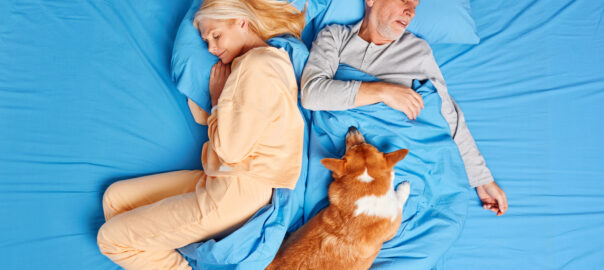
Sleep is so important for our well-being, and I’ve come to think of it as one of my best defenses against aging. So it has always seemed ridiculous to consider how many hours I’ve lain in bed in an awkward position, knees burning from immobility, because I didn’t want to disturb my sleeping prince, Charlie, a giant orange tabby and the love of my life, cuddled in a contented ball between my legs. Never mind that this same prince slept nineteen hours the previous day. I’d lie there, uncomfortable and wide awake, watching the ceiling fan make its lazy circles while Charlie purred contentedly on my bloodless legs.
As it happens, I was right to worry about being the one doing the disturbing. In a new University of Toronto study published this October, people wore sleep trackers on their wrists and their dogs wore them on their collars for four weeks. When human and dog nighttime movements were linked, the human moved first about 45 percent of the time, compared with about 18 percent for the dog. In other words, we’re the restless ones. And sharing a bed with a dog didn’t measurably cost the humans any sleep. The study was small and included only huskies and malamutes, not cats, but I suspect Charlie would have recognized the pattern.
My peternal instincts, it seems, may not have been far off. Research increasingly suggests that sleep matters just as much for our furry, feathered, and scaly companions as it does for us. And understanding how different species sleep can help us provide better care for all our animal family members.
The Science of Animal Sleep
Sleep helps animals recharge, and research suggests it plays a role in emotional regulation and memory as well. Two main stages do much of that work: slow-wave (deep) sleep and REM sleep, the stage most associated with dreaming. Researchers have documented both stages in cats, dogs, horses, and birds, and recent studies have found similar stages in some lizards. How much time each species spends in each stage varies widely.
Cats were among the first animals in which REM sleep was identified, in the late 1950s. During REM sleep, cats experience atonia, a temporary muscle paralysis that scientists believe keeps them from acting out their dreams and hurting themselves. French neuroscientist Michel Jouvet showed what happens without it. When a small area of the brainstem responsible for this paralysis was damaged, sleeping cats lifted their heads, looked around, and in some cases walked or pounced as if hunting, all while still asleep.
Cats now live in 46 million U.S. households, up from 43.1 million just a year ago, according to the American Veterinary Medical Association’s 2026 pet ownership data. Yet cat sleep has been studied far less than dog sleep, and some of the most useful new findings are about light. Researchers think a cat’s internal clock is fairly flexible, set in large part by the world around it: when the lights go on, when meals arrive, and when its people are up and about. A 2025 Michigan State University study of 101 shelter cats shows how strong that pull is. No matter what kind of light the cats lived under, their busiest moment of the day came when the lights switched on. The type of light mattered, too. Cats under dim, warm-toned light, like a sunset, had the lowest levels of the stress hormone cortisol, while cats under plain dim light hid more. These were shelter cats, not pets at home, but the message carries over: our cats’ days and nights may run on our schedule more than we realize.
How Much Do Cats Sleep?
Most healthy adult cats sleep somewhere around 12 to 16 hours a day, and kittens and seniors often sleep more. Cats also tend to sleep in many short stretches rather than one long one, which is why a cat can seem to be napping all day and still be wide awake when you want to sleep. What matters most is change. A cat who suddenly sleeps more than usual, especially along with eating less, hiding, or letting grooming slide, is worth a call to your vet.
Dogs Dream Too
Dog sleep looks a lot like ours. Studies using polysomnography, the same kind of sleep recording used in human sleep labs, show that dogs cycle through drowsiness, deep sleep, and REM sleep much as people do. So do dogs dream? We can’t ask them, but their sleeping brains behave a lot like ours do when we’re dreaming, which is what many pet parents have long suspected.
Sleep may also tell us something about how dogs age. In a 2023 study that recorded afternoon naps in 28 senior dogs, those with higher dementia scores and poorer results on a problem-solving task spent less time in both deep and REM sleep.
Who’s in the room seems to matter, too. In a small 2025 sleep-lab study, dogs took longer to fall asleep, slept less efficiently, and got considerably less deep sleep when their person stepped out and a friendly stranger stayed with them instead. With only nine dogs tested in an unfamiliar lab, the researchers caution against drawing conclusions about home sleeping arrangements. Still, it’s a sweet glimpse of how much our presence may mean to them.
Helping Your Dog or Cat Sleep Well
Understanding these sleep patterns helps us provide better care. Plenty of exercise and mental stimulation during waking hours can help your dog or cat rest more deeply. A tired pet is often a sleeping pet, and the quality of that sleep matters.
Should you wake a dreaming dog? If you notice your dog or cat twitching, whimpering, or paddling their paws in their sleep, resist the urge. They’re likely in REM sleep. A pet startled awake can be disoriented, and some may react defensively, so it’s kinder to let them be. I must admit, I can’t resist giving their dreams a happy edge. When my big guy, Pinto, was dreaming, I could quietly coo to him and tell him he was a good boy without waking him. Then, his sleep running would pick up speed, and his tail would do a baby-wag. Adorable.
If your cat seems to run on a different clock than you do, there’s a reason for that. Cats sleep in short bouts around the clock, but their busiest stretches tend to come at dawn and dusk.
“Does it feel like you are on opposite schedules from your pet? You may be! Crepuscular animals such as cats are biologically designed to be most active in the early morning and evening. This aligns with their ancestors’ hunting and napping patterns. That’s why your cat is so good at waking you up for breakfast and also why sometimes just as you are winding down, she appears to be winding up.” — John D. Boone, PhD, Wildlife Ecologist, Board Member, Petopia.org
Do Horses Sleep Standing Up?
Yes and no. Horses can doze while standing, thanks to a specialized stay apparatus in their legs that lets them lock their joints. But they can’t reach REM sleep standing up, because their muscles lose tone during this stage. For REM, a horse has to lie down.
Researchers at the University of Veterinary Medicine Vienna note that horses need at least thirty minutes of lying down per day to get the three and a half to four and a half minutes of REM sleep that keeps them from becoming sleep-deprived. Horses that don’t get enough recumbent sleep can become excessively drowsy. Some slip into REM while standing and partially collapse before jolting awake, which can lead to serious injuries. In the Vienna team’s study of 83 horses, the eight that showed signs of REM deficit lay down for an average of about eight minutes a day, compared with roughly 74 minutes for the others.
As a prey species, horses lie down when they feel comfortable and safe. Pain, stress, social pressure within a herd, and unsuitable housing can all keep a horse on its feet. Bedding matters too. In one study of group-housed horses, those without access to a soft, bedded area rarely lay down, and horses spent more time lying down as the bedded area grew larger. A 2025 study of young riding horses found some indications that open space and a companion during the day increased lying-down time, both that day and the following night.
What does a sleep-deprived horse look like? A 2025 survey of Nordic horses linked suspected sleep problems with taller size, older age, and hard or wet bedding. The horses owners flagged were more likely to have trouble lying down or getting up, to never be seen lying down at all, to be sleepy during the day, or to lose their balance unexpectedly.
The Circadian Connection: Reptile and Bird Sleep
For reptiles and birds, light plays an especially visible role in healthy sleep. Their circadian rhythms, the internal clocks that run on a roughly 24-hour cycle, are closely tied to the daily light and dark cycle.
A 2023 study of the Australian bearded dragon found that the lizards’ sleep still followed a roughly 24-hour rhythm in constant darkness. But the regular back-and-forth between REM and slow-wave sleep broke down without light. Once the dragons had twelve hours of light again, the regular pattern of their sleep stages returned. A 2024 study from the Max Planck Institute adds another twist: brief pulses of light shone on the closed eyes of sleeping bearded dragons reliably reset their sleep cycle. Light, in other words, reaches a sleeping lizard’s brain.
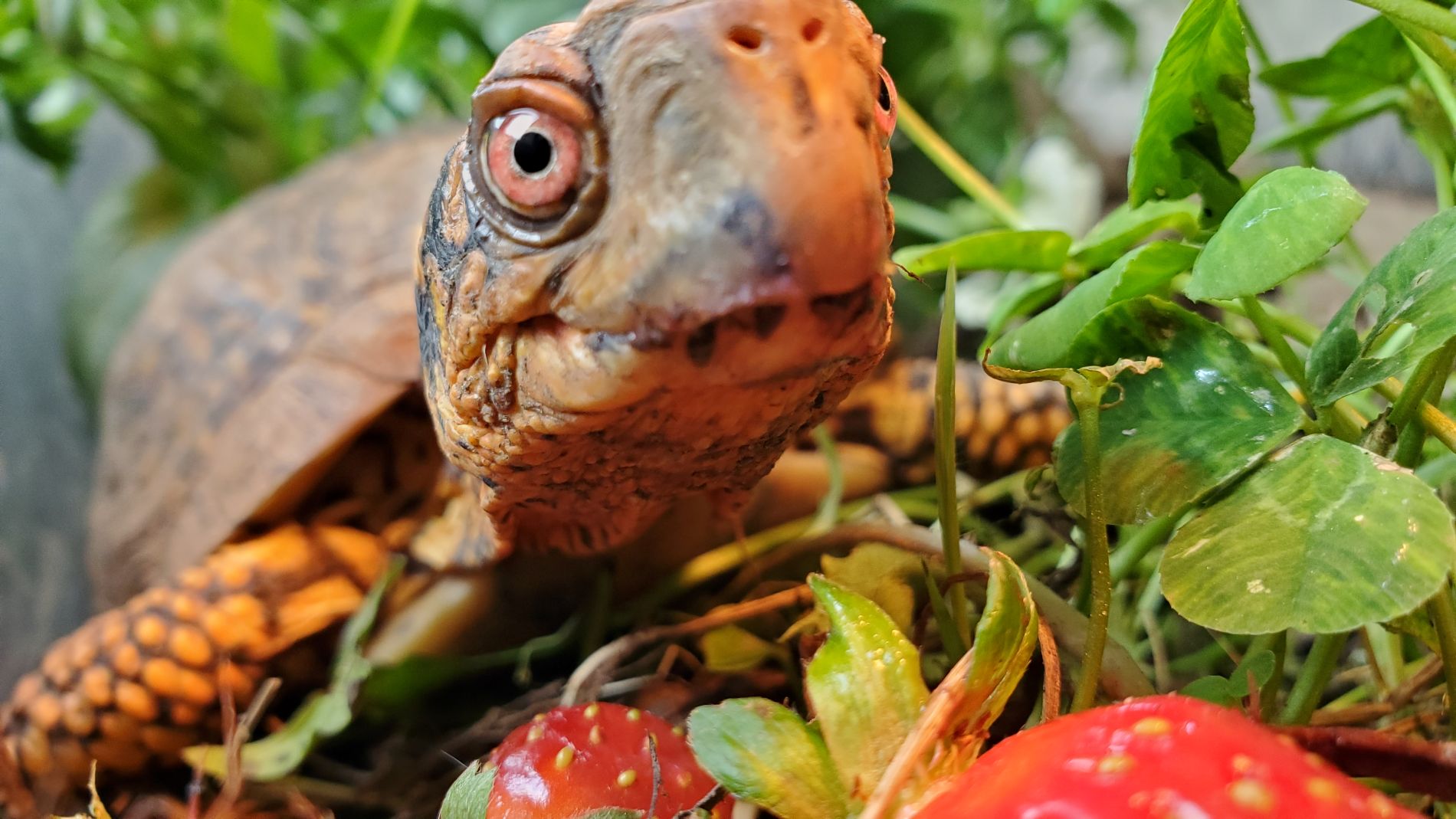
Sydney, my box turtle, has a ceramic lamp that doesn’t produce light for heat during the night.
Finding this research delighted and horrified me. Many reptile enclosures use heat lamps, and some keepers leave a lamp on overnight for warmth, often a red bulb advertised as invisible to reptiles. Vision research suggests otherwise: diurnal lizards, including close relatives of the bearded dragon and maybe even like my best buddy, Syd, have cone cells tuned to red wavelengths. A lamp glowing all night, red or not, may be keeping your reptile in a kind of permanent dim day. We have so much to learn to be great pet parents to our reptiles. It turns out that a slight nighttime drop in temperature may be healthier, too.
Keep reptile nights dark, using heat sources like ceramic heaters that don’t give off light. You don’t want to overheat the enclosure, so use a thermostat to ensure the temperature is appropriate. If your home stays above 70 degrees at night, some reptiles may not need extra heat, since a nighttime temperature drop is healthy for most species. —Hayley Grove, DVM, Brookhaven, Georgia.
Bird sleep turns out to be more complex than scientists once believed. A study of budgerigars, the small parakeets many of us grew up with, found abundant REM sleep, a distinct intermediate sleep stage, and daily and shorter cycles in sleep structure that mirror those in mammals. The researchers also showed that the constant lighting used in older bird sleep studies dramatically disrupted the budgies’ sleep, roughly halving it. That finding suggests more complex sleep may have been overlooked in many bird species.
Feeling safe matters for birds, too. A 2025 review of bird sleep research notes that pigeons get less REM sleep when they sleep closer to the ground, where they feel more exposed to nighttime predators. Pet birds may not face real predators, but a perch that feels high and secure may help them settle into deeper rest.
For pet parents, this research has practical implications. Consistent light and dark periods help reptiles and birds maintain healthy sleep patterns. A light timer, a cage cover, or simply a predictable schedule for lights on and lights off can all help.
Why Sleep Matters for Pet Health
Sleep deprivation in pets can have real consequences. In horses, too little lying-down time is linked to collapse and injury, and researchers studying horses with very short lying times saw signs of compromised overall well-being.
A caveat about the next findings: some of the most striking sleep research comes from laboratory rats, not pets. In landmark studies in the late 1980s, rats kept from sleeping ate more than usual yet still lost weight, and their energy use climbed to more than twice its normal level. Every one of them died within about two to five weeks. Pets at home don’t face anything like this kind of enforced, total sleep loss. But these experiments helped convince scientists that sleep is a biological necessity, not optional downtime.
Understanding species-specific sleep needs allows us to be better advocates for our pets. When we recognize that a horse with scraped knees or unexplained stumbles might be sleep-deprived, or that changes in a bird’s or reptile’s behavior might stem from a disrupted light schedule, we can look for the root cause rather than just treating symptoms.
Practical Takeaways
So was my sacrifice—those hours of motionless discomfort, watching Charlie sleep—worth it? The research suggests yes. My instinct to protect my pet’s sleep was sound, even if the execution left something to be desired for my own rest.
Here’s what we can do as pet parents to support healthy sleep in our animal companions:
- Make sure dogs and cats get exercise and mental stimulation during waking hours.
- Let dreaming pets sleep unless you need to wake them.
- Notice changes in your cat’s sleep, especially alongside changes in appetite, grooming, or hiding.
- Give horses spacious, well-bedded areas that encourage lying down, and companionship when possible.
- Watch horses for trouble lying down or getting up, daytime sleepiness, or unexpected stumbles.
- Keep reptile and bird nights dark, including turning off heat lamps and colored “night” bulbs, and ask your vet about night heat if your reptile needs it.
- Give pet birds a perch that feels high and secure.
- Address any pain or medical issues that might prevent comfortable rest.
- Create safe, quiet sleeping spots for every species in your home.
The next time you find yourself contorted like a pretzel because your cat has claimed the comfortable spot in bed, remember: you’re not being ridiculous. You’re protecting something your pet’s body and brain rely on. Your sleeping pet is likely doing important work, recharging for another day of enriching your life in countless ways. That’s worth a few hours of awkward positioning.
Maybe just invest in a bigger bed.
Charlie is long gone now, may he rest in peace. These days it’s Sugar Dog, my almost-feral girl, who sneaks in through the dog door at night to sleep in my bed. It is so special. But, if I so much as wiggle, she bolts off the bed like a rocket. So I’m being very still. I’m just glad to have a warm buddy, and I think we both sleep better with another heartbeat nearby. That little study of dogs sleeping more deeply with their person close by makes me think I’m right.
The Research Behind This Post
Curious to dig deeper? Here are the studies mentioned in this article.
Pets and their people
- Who wakes whom at night: Li, M. F., et al. (2026). Who is disrupting whom? Examining the nighttime activity patterns of humans and their dogs. PLOS One. https://doi.org/10.1371/journal.pone.0358453
- Dogs sleep better with their person nearby: Baranyai, L., et al. (2025). Animals. https://doi.org/10.3390/ani15213182
Cats
- U.S. cat and dog populations: American Veterinary Medical Association (2026). 2026 AVMA Pet Ownership and Demographics Sourcebook. https://www.avma.org/news/dogs-still-reign-cats-are-closing-gap-avma-data-show
- How light affects cats’ stress and daily rhythms: Yaw, et al. (2025). Light quality and time in shelter modulate behavior and cortisol in the domestic cat (Felis catus). iScience. [DOI to add]
- Jouvet’s dreaming cats: Jones, B. E. (2018). The mysteries of sleep and waking unveiled by Michel Jouvet. Sleep Medicine. https://doi.org/10.1016/j.sleep.2018.05.030
Dogs
- Sleep and aging in senior dogs: Mondino, A., et al. (2023). Sleep and cognition in aging dogs. Frontiers in Veterinary Science. https://doi.org/10.3389/fvets.2023.1151266
Horses
- How much horses need to lie down: Kelemen, Z., et al. (2021). Animals. https://doi.org/10.3390/ani11113189
- Bedding space and lying down: Burla, J.-B., et al. (2017). Frontiers in Veterinary Science. https://doi.org/10.3389/fvets.2017.00023
- Companions, space, and rest: Helmerich, P., et al. (2025). Equine Veterinary Journal. https://pubmed.ncbi.nlm.nih.gov/38163442/
- Signs of sleep problems in horses: Suomala, et al. (2025). Equine Veterinary Journal. https://doi.org/10.1111/evj.14560
Reptiles and birds
- Bearded dragon sleep and light: Yamaguchi, S. T., et al. (2023). PNAS Nexus. https://doi.org/10.1093/pnasnexus/pgad481
- Light resets a sleeping lizard’s cycle: Fenk, L. A., et al. (2024). Nature. https://doi.org/10.1038/s41586-024-08162-w
- Lizards see red: Yewers, M. S., et al. (2015). Journal of Experimental Biology. [DOI to add]
- Budgie sleep: Canavan, S. V., & Margoliash, D. (2020). PLOS Biology. https://doi.org/10.1371/journal.pbio.3000929
- Feeling safe and bird sleep: Patel, et al. (2025). Journal of Avian Biology. https://doi.org/10.1002/jav.03454
Spiders
- Two-stage sleep in jumping spiders: Geiger, N., et al. (2026). Proceedings of the National Academy of Sciences. https://doi.org/10.1073/pnas.2618030123
Lab research on sleep loss
- Everson, C. A., Bergmann, B. M., & Rechtschaffen, A. (1989). Sleep deprivation in the rat: III. Total sleep deprivation. Sleep, 12(1), 13–21.
- Kushida, C. A., Bergmann, B. M., & Rechtschaffen, A. (1989). Sleep deprivation in the rat: IV. Paradoxical sleep deprivation. Sleep, 12(1), 22–30.